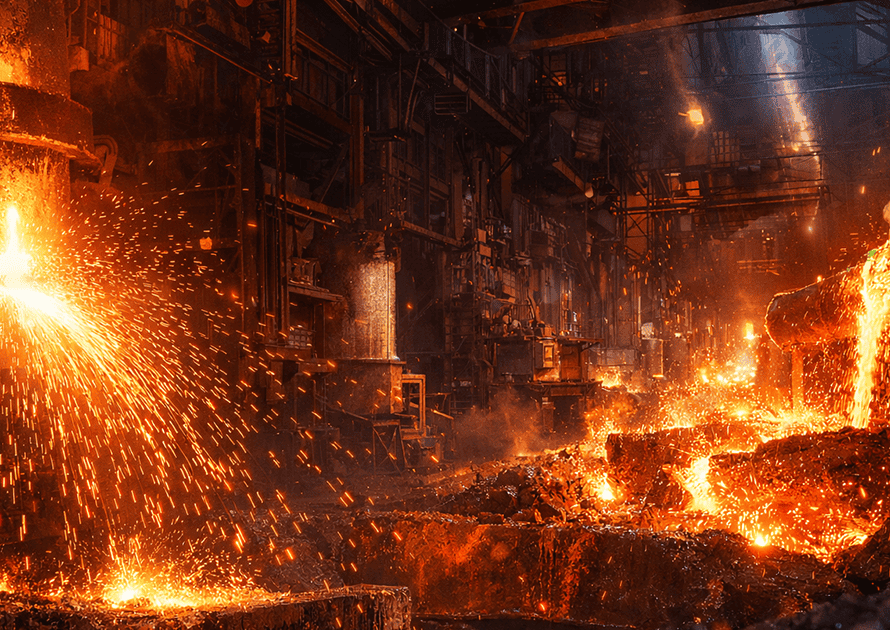
Ferro Manganese (FeMn) is a ferroalloy consisting primarily of manganese and iron, with carbon and other elements present depending on the grade and production process.
It is one of the most important manganese-bearing ferroalloys used in the steel industry. Ferro Manganese is added to molten steel to provide manganese, help control sulfur, support deoxidation, and improve important mechanical and metallurgical properties of the finished steel.
Manganese is considered essential to steel production because of its sulfur-fixing, deoxidizing, and alloying functions. The U.S. Geological Survey notes that manganese ferroalloys such as ferromanganese and silicomanganese provide most of the manganese used in steelmaking.
Why Is Ferro Manganese Important in Steelmaking?
During steel production, controlling the chemical composition of molten steel is critical. Ferro Manganese provides a practical and efficient way of introducing manganese into the melt.
Its major functions include:
1. Manganese Alloying
Manganese contributes to the strength and hardenability of steel. The required manganese level depends on the steel grade and the desired properties.
2. Sulfur Control
Manganese has a strong affinity for sulfur. It helps reduce the harmful effects of sulfur by promoting the formation of manganese sulfide rather than allowing excessive iron sulfide formation.
This is particularly important because uncontrolled sulfur can contribute to hot-shortness and adversely affect steel processing.
3. Deoxidation
Manganese participates in the deoxidation of molten steel. It can help reduce dissolved oxygen and contributes to cleaner steelmaking practice when used as part of the overall deoxidation strategy.
4. Improved Mechanical Properties
Manganese can contribute to improvements in:
- Strength
- Hardness
- Hardenability
- Wear resistance
- Toughness, depending on steel chemistry and processing
USGS identifies ferromanganese and silicomanganese as key manganese ferroalloys used for deoxidation, desulfurization/sulfur control, and alloying in steel production.
How Is Ferro Manganese Produced?
Ferro Manganese is generally produced by smelting and reducing manganese-bearing raw materials in an electric furnace.
A simplified production route is:
Manganese Ore + Reductant + Fluxes → Electric Furnace → Reduction & Smelting → Molten Ferro Manganese → Casting → Crushing & Sizing
Step 1: Selection of Manganese Ore
Manganese ore is the primary source of manganese. The chemistry and physical characteristics of the ore influence furnace performance and final alloy quality.
Step 2: Raw Material Preparation
Depending on the plant process, raw materials may be:
- Sized
- Screened
- Blended
- Dried
- Agglomerated
Proper raw-material preparation helps maintain stable furnace operation.
Step 3: Electric Furnace Smelting
The prepared charge is introduced into an electric furnace along with a carbonaceous reductant and other required materials.
High temperatures facilitate the reduction of manganese oxides and the formation of the ferroalloy.
Step 4: Reduction
Carbon acts as the principal reducing agent, removing oxygen from manganese oxides.
The resulting molten alloy contains manganese, iron, carbon and smaller quantities of other elements.
Step 5: Tapping and Casting
The molten Ferro Manganese is tapped from the furnace and cast into suitable forms.
Step 6: Crushing and Screening
After solidification, the alloy is crushed and screened into customer-specified sizes.
USGS describes ferromanganese production as involving manganese ore and iron-bearing materials with carbon in electric furnaces; the resulting iron-bearing alloy is subsequently used to introduce manganese into liquid steel.
Types of Ferro Manganese
Ferro Manganese is available in different grades depending mainly on manganese, carbon, silicon, phosphorus and other residual-element requirements.
The three broad categories are:
1. High Carbon Ferro Manganese
High Carbon Ferro Manganese (HC FeMn) is widely used in conventional steelmaking applications.
It provides manganese efficiently while also introducing carbon into the steel.
Typical applications include:
- Carbon steel
- Structural steel
- Construction steel
- Long products
- General engineering steels
The exact chemistry should always be specified according to the applicable product standard and customer requirement.
2. Medium Carbon Ferro Manganese
Medium Carbon Ferro Manganese (MC FeMn) is selected when manganese is required while keeping carbon addition more tightly controlled than with high-carbon grades.
It can be useful in steel grades where carbon limits are more restrictive.
Applications can include:
- Engineering steels
- Alloy steels
- Special steel grades
- Applications requiring controlled carbon chemistry
3. Low Carbon Ferro Manganese
Low Carbon Ferro Manganese (LC FeMn) is used where manganese must be added while minimizing carbon pickup.
This makes it particularly relevant for steel grades with stringent carbon specifications.
Applications may include:
- Special steels
- Low-carbon steels
- High-performance engineering steels
- Certain stainless and alloy steel applications
Important: Exact grade chemistry varies by specification and supplier. Steelmakers should evaluate the certificate of analysis and applicable standard rather than selecting material solely by the grade name.
What Should Steelmakers Consider When Buying Ferro Manganese?
For steelmakers, purchasing decisions should go beyond simply looking at the manganese percentage.
1. Manganese Content
Higher recoverable manganese can influence alloy consumption and overall addition efficiency.
2. Carbon Content
Carbon pickup is critical for steel grades with tight carbon limits.
3. Silicon Content
Silicon affects the overall steel chemistry and deoxidation practice.
4. Phosphorus and Sulfur
Low and controlled residual levels can be important for demanding steel grades.
5. Particle Size
Consistent sizing helps improve:
- Charging
- Melting
- Recovery
- Addition control
- Process consistency
6. Recovery Rate
Theoretical manganese content does not tell the whole story. Steelmakers should consider the actual manganese recovery achieved in their process.
7. Consistency
Consistent chemistry from batch to batch is essential for reliable steelmaking.
8. Supplier Reliability
A dependable ferroalloy supplier should provide:
- Consistent chemistry
- Reliable sizing
- Batch traceability
- Test certificates
- Stable supply
- Technical support
- On-time delivery
How Is Ferro Manganese Added to Molten Steel?
Ferro Manganese is normally added during the steelmaking process when the molten steel chemistry is adjusted.
A simplified sequence is:
Molten Steel → Chemical Analysis → Alloy Requirement Calculation → FeMn Addition → Mixing → Final Analysis → Casting
The actual addition practice depends on the steelmaking route, furnace type, steel grade, temperature, slag practice and desired recovery.
Metallurgists typically calculate the required addition based on:
- Initial manganese content
- Target manganese content
- Weight of molten steel
- Alloy manganese content
- Expected recovery
A simplified calculation is:
Required FeMn ≈ Required Mn addition ÷ (Mn content in alloy × expected recovery)
Actual plant calculations should account for process-specific recovery and other alloy additions.
Applications of Ferro Manganese
Ferro Manganese is used across a broad range of steel products.
Construction Steel
Used in steel products where strength and durability are important.
Structural Steel
Manganese contributes to the mechanical-property profile required by structural applications.
Engineering Steel
Used for controlled alloying in engineering and machinery applications.
Rail Steel
Manganese is an important component in many rail-steel chemistries, where strength and wear performance are critical.
Automotive Steel
Selected grades can use manganese as part of the alloying system for automotive applications.
Special and Alloy Steels
Medium- and low-carbon Ferro Manganese can be useful where carbon control is important.
Advantages of High-Quality Ferro Manganese
For steelmakers, consistent Ferro Manganese can provide several process benefits:
✓ Reliable manganese recovery
✓ Controlled alloy chemistry
✓ Better process consistency
✓ Predictable carbon contribution
✓ Controlled residual elements
✓ Consistent particle sizing
✓ Improved batch-to-batch reproducibility
Ultimately, the objective is not simply to purchase a high-manganese alloy. The objective is to achieve consistent metallurgical performance at the lowest effective cost per tonne of finished steel.
Ferro Manganese Quality: What Matters Most?
A good Ferro Manganese specification should consider the complete chemistry rather than manganese content alone.
Key parameters include:
- Mn %
- C %
- Si %
- P %
- S %
- Fe %
- Size distribution
- Moisture
- Fines
- Batch consistency
For critical steel grades, the supplier’s Certificate of Analysis (COA) should be reviewed against the agreed specification.
Sustainability and Ferro Manganese Production
The ferroalloy industry is energy intensive, making energy efficiency and carbon management increasingly important.
Steelmakers are increasingly evaluating not only alloy chemistry and price but also:
- Carbon footprint
- Energy efficiency
- Responsible sourcing
- Process emissions
- Environmental management
- Supply-chain transparency
As the steel industry moves toward lower-carbon production, ferroalloy suppliers have an important role to play in supporting the transition toward more sustainable steelmaking.
Why Choose a Reliable Ferro Manganese Supplier?
For steelmakers, ferroalloy quality directly influences process control.
A reliable supplier should combine:
Quality + Consistency + Technical Support + Reliable Supply + Traceability
The right Ferro Manganese partner can help steel producers optimize alloy consumption, maintain chemistry control and improve production consistency.
Frequently Asked Questions
What is Ferro Manganese?
Ferro Manganese is an iron-manganese ferroalloy primarily used to introduce manganese into molten steel. It also supports sulfur control, deoxidation and alloying.
What is the main use of Ferro Manganese?
Its primary use is in steelmaking as a source of manganese for controlling steel chemistry and improving selected metallurgical properties.
What are the main types of Ferro Manganese?
The major categories are High Carbon, Medium Carbon and Low Carbon Ferro Manganese.
Why is manganese added to steel?
Manganese is added for its alloying, sulfur-fixing and deoxidizing functions and to influence properties such as strength and hardenability.
What is the difference between Ferro Manganese and Silico Manganese?
Ferro Manganese primarily supplies manganese, while Silico Manganese supplies both manganese and significant silicon, making it particularly useful where manganese addition and silicon-based deoxidation/alloying are required.
How do I select the right Ferro Manganese grade?
Selection depends on the target steel chemistry, manganese requirement, carbon limit, silicon requirement, residual-element limits, recovery and furnace practice.
Conclusion
Ferro Manganese is a fundamental ferroalloy in modern steelmaking. Its ability to introduce manganese efficiently while contributing to sulfur control, deoxidation and alloying makes it an essential material across numerous steel grades.
For steelmakers, selecting the right Ferro Manganese grade is about more than manganese percentage. Chemistry, carbon level, residual elements, particle size, recovery, consistency and supplier reliability all influence the final result.
With the continued evolution of steelmaking toward higher efficiency and lower environmental impact, the quality and sustainability of ferroalloy production will become increasingly important.
Berry Alloys can position its Ferro Manganese portfolio around these priorities: consistent chemistry, reliable quality, controlled sizing and dependable supply for modern steelmaking.